Blog

HEALTHY THAI FOOD BEYOND SALADS

Healthy Thai Food Beyond Salads

When people think of healthy food, they often imagine grilled chicken salads, steamed vegetables, or bland meals eaten simply for the sake of staying healthy.

But if you visit Thailand, you may be surprised to discover that many Thai dishes are naturally packed with fresh vegetables, herbs, and aromatic spices—without sacrificing flavor or enjoyment.

Here are some delicious Thai dishes that are naturally lower in fat and are great choices for anyone looking for healthier Thai food.


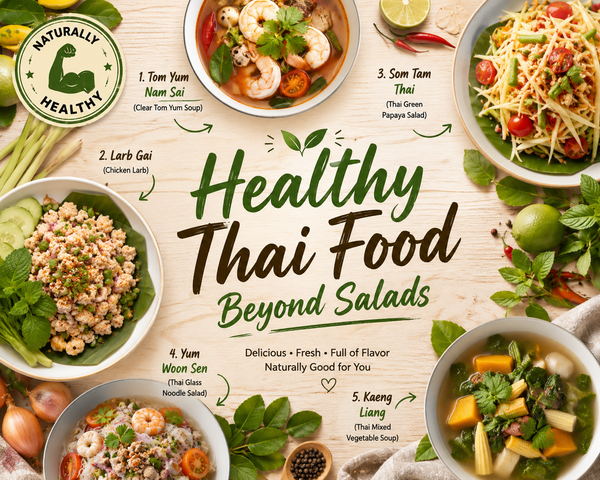
1. Tom Yum Nam Sai (Clear Tom Yum Soup)

Tom Yum is one of Thailand’s most famous soups, known for its fragrant combination of lemongrass, galangal, kaffir lime leaves, and mushrooms.

If you choose the clear broth version instead of the coconut milk version, you’ll enjoy a refreshing soup that’s naturally lower in fat while still full of authentic Thai flavors.


2. Larb Gai (Chicken Larb)

Chicken Larb is made with minced chicken tossed with fresh lime juice, roasted rice powder, and fragrant herbs such as shallots, spring onions, and mint.

It’s high in protein, full of fresh herbs, and when served with fresh vegetables, it becomes a well-balanced meal that provides protein, vitamins, and dietary fiber.


3. Som Tam Thai (Thai Green Papaya Salad)

Som Tam is one of Thailand’s most iconic dishes, made with shredded green papaya, tomatoes, long beans, and peanuts.

Its appeal comes from the perfect balance of sweet, sour, salty, and spicy flavors. The spice level can easily be adjusted—from no chili at all to extra spicy—making it suitable for almost everyone.


4. Yum Woon Sen (Thai Glass Noodle Salad)

Yum Woon Sen combines glass noodles with fresh vegetables, herbs, and protein such as shrimp or minced pork.

Its refreshing lime dressing makes it light, flavorful, and satisfying without feeling too heavy.


5. Kaeng Liang (Thai Mixed Vegetable Soup)

Kaeng Liang is a traditional Thai vegetable soup filled with a variety of vegetables such as pumpkin, sponge gourd, baby corn, and lemon basil.

The clear broth is lightly seasoned with black pepper and Thai herbs, creating a comforting dish that’s both light and packed with vegetables.


Healthy Thai Food Is More Than You Think

One of the unique characteristics of Thai cuisine is its generous use of fresh vegetables, herbs, spices, and seasonal ingredients. Many Thai dishes are naturally rich in flavor without relying heavily on cream or large amounts of fat.

The next time you visit Thailand, don’t be afraid to explore beyond the famous dishes. You may discover that healthy Thai food is just as delicious as it is diverse.

And if you’d like to learn how to prepare authentic Thai dishes yourself—from selecting fresh ingredients at a local market to balancing Thai flavors like a local—we’d love to welcome you to Classic Home Cooking.


Is Thai Food Always Spicy?

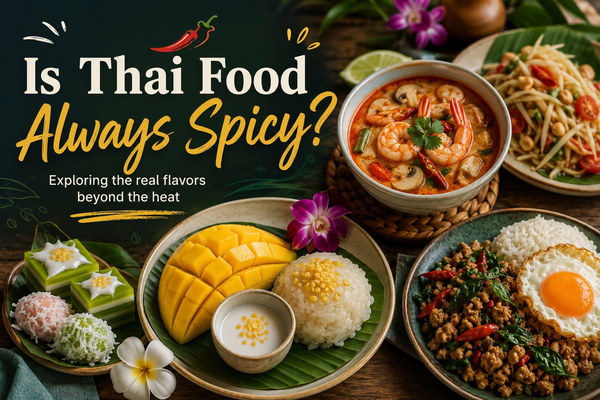
Is Thai Food Always Spicy? No. Thai food is not all about spiciness. Spiciness is an important part of many Thai dishes, but it is only one part of the full range of flavors found in Thai food. Thai cuisine includes spicy, salty, sour, sweet, bitter, and astringent flavors. But that does not mean every dish needs to include all of them. Each dish has its own character. Some dishes are led by sourness. Some are mainly salty and spicy. Others are gently sweet, while some use bitterness or astringency as part of their unique character. And many Thai dishes are not spicy at all. That is what makes Thai food so interesting. There are so many different flavors to discover, but each dish does not need to be everything at once. Why, Then, Is Thai Food Known for Being Spicy? One reason may be that spiciness is easy to remember, especially for people who are not used to eating chilies. The heat in your mouth or the sweat on your face can leave a strong impression. Many Thai dishes that are famous around the world are also known for their bold flavors, such as Tom Yum, Som Tam, and different types of Thai curry. So it is not surprising that “spicy” is often one of the first words people think of when they hear “Thai food.” But if you look at what Thai people actually eat, you will find that the world of Thai food is much wider than that. Kai Palo, clear soups, Pad See Ew, Massaman Curry, Pad Thai, and Thai omelets are all familiar dishes in Thailand. No one would question whether they are Thai simply because they are not spicy. The Same Dish Does Not Have to Be Equally Spicy Every Time Another thing many people may not realize is that the level of spiciness in Thai food does not depend only on the name of the dish. It also depends on the preferences of the person cooking it and the person eating it. Thai people do not all eat the same level of spice. Some love very spicy food, some prefer just a little heat, and others hardly eat spicy food at all. That is why the spice level of many Thai dishes can be adjusted to suit different people. Pad Kra Pao is a good example. For one person, the chilies may be used to give the dish a pleasant level of heat and add to its aroma and flavor. Someone who loves spicy food, however, may add much more chili and turn the same Pad Kra Pao into a very spicy dish. Both are still Pad Kra Pao. The same is true for Som Tam, Yum, and many other Thai dishes. In a Thai kitchen, the cook does not only think about how many chilies the recipe requires. They also think about how spicy the person eating it likes their food. So, if you have tried a Thai dish and found it extremely spicy, that does not mean the dish must always be served at that level of heat. When it is cooked by a different person, eaten in a different home, or ordered from a different restaurant, both the flavor and the spice level may be different. Thai Food Has a Full Range of Flavors, but Every Dish Has Its Own Character When people talk about Thai food, we often hear the phrase “balance of flavors.” That is true, but “balance” does not mean that every Thai dish must contain equal amounts of sweet, sour, salty, and spicy flavors. It also does not mean that every dish must include every flavor. Tom Yum should not taste like Green Curry. Pad Kra Pao should not taste like Pad Thai. And a clear soup does not need to be bold or spicy to prove that it is Thai. Every dish has its own character. In Tom Yum, sourness may be the leading flavor, while saltiness, spiciness, and the aroma of herbs work together around it. In a coconut curry, the richness of coconut milk may work together with saltiness, sweetness, spiciness, and the aroma of curry paste. Some Thai dishes may also use bitterness or astringency as part of their unique character. So balance in Thai food is not about making every flavor equal. It is about understanding what should lead, what should follow, and how all the elements should work together in that particular dish. This is one of the charms of Thai food. We have almost every kind of flavor to discover, but not every dish tries to be everything at once. Thai Food Is Not Only About Taste. It Is Also About Aroma. Sometimes, before we even taste Thai food, we already know what is being cooked in the kitchen. The aroma of galangal, lemongrass, and makrut lime leaves rising from a pot of Tom Yum, the smell of holy basil hitting a hot wok, or the aroma of curry paste as it is being fried are all part of Thai food that the word “spicy” alone cannot explain. Even chilies do more than simply create heat. Fresh chilies, dried chilies, and roasted chilies can bring different aromas, colors, and flavors to a dish. The same is true for galangal, lemongrass, garlic, shallots, coriander root, makrut lime leaves, and many other Thai herbs and ingredients. They all help create the unique character of each dish. That is why two dishes with a similar level of heat can still feel completely different. The spiciness of Pad Kra Pao is not the same as the spiciness of Gaeng Pa, and the heat of Som Tam is not the same as the heat of Nam Prik. Because everything surrounding that spiciness is different. Can You Still Enjoy Thai Food If You Do Not Eat Spicy Food? Absolutely. Not eating spicy food does not mean you have to miss out on Thai food. And reducing the amount of chili does not automatically take away the identity of every dish. If you are just beginning to explore Thai food, you can start with milder dishes and gradually discover the aromas of Thai herbs, the richness of coconut milk, the sourness of lime or tamarind, the saltiness and aroma of different seasonings, and the many different flavors and textures found in Thai cooking. For dishes where the spice level can be adjusted, you do not have to start at the same level as someone who has been eating chilies since childhood. Because in the end, Thai food is not all about spiciness. Some dishes are very spicy. Some are only mildly spicy. Some are not spicy at all. And even the same dish does not have to be equally spicy for everyone. Spiciness is just one part of a much bigger world of Thai food—a world filled with different flavors, aromas, ingredients, and unique characters. And perhaps a more interesting question than “How spicy is this dish?” is: “What makes this dish taste the way it does?”
10 Thai Desserts You Should Try Besides Mango Sticky Rice

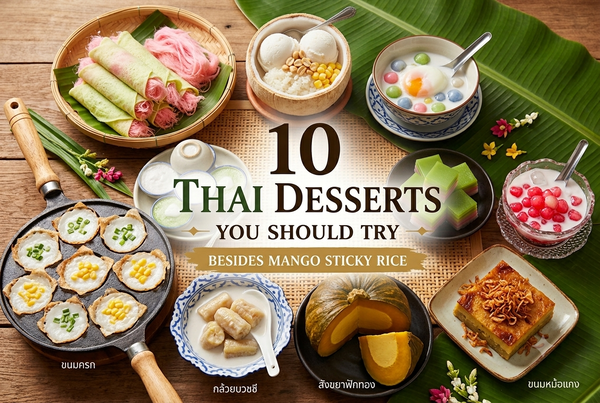
10 Thai Desserts You Should Try Besides Mango Sticky Rice When people think of Thai desserts, Mango Sticky Rice is often the first dish that comes to mind. And that is hardly surprising, as it has become popular around the world and can now be found in many Thai restaurants. However, if you have the chance to visit Thailand, do not stop at Mango Sticky Rice. These 10 Thai desserts might help you discover a new favorite you never expected. ⸻ 1. Khanom Krok If you are walking through a market in Thailand and notice the wonderful aroma of coconut milk in the air, there is a good chance that someone nearby is making Khanom Krok. These small coconut pancakes are made from rice flour and coconut milk, then cooked in a special pan with round moulds. The outside becomes slightly crisp, while the inside remains soft, creamy, and rich with coconut flavor. Some vendors also add toppings such as spring onions, sweet corn, or taro, giving each version its own character. Khanom Krok tastes best when it is fresh from the pan, when you can enjoy the crisp outside and soft, delicate center at the same time. ⸻ 2. Roti Sai Mai Many people are familiar with cotton candy, but Roti Sai Mai is something different. This famous sweet from Ayutthaya is made by wrapping fine strands of spun sugar in a thin roti sheet, then rolling it up and eating everything together. Although Roti Sai Mai can now be found in several parts of Thailand, most Thai people still think of Ayutthaya first when they hear its name. It is also a popular souvenir for visitors to take home after exploring the historic city. ⸻ 3. Coconut Ice Cream When you order coconut ice cream from a traditional street vendor in Thailand, the seller may ask, “Would you like sticky rice?” or “Would you like peanuts on top?” For many traditional vendors, this is the classic way to serve it. Fragrant coconut ice cream is paired with sticky rice and roasted peanuts, adding extra aroma and contrasting textures to this simple dessert. ⸻ 4. Bua Loy with Sweet Egg Bua Loy is made from glutinous rice flour shaped into small, bite-sized balls. They have a pleasantly soft and chewy texture and are served in warm, fragrant coconut milk. The highlight is the sweet egg, which is gently cooked in syrup until the yolk remains soft and creamy. When the coconut milk, chewy rice balls, and sweet egg are eaten together, they create a rich and distinctive combination of flavors and textures. ⸻ 5. Khanom Chan Khanom Chan is a traditional steamed Thai dessert made with flour and coconut milk. It is known for its beautiful colors and thin layers, which are carefully steamed one at a time. Part of its charm is the way people eat it. Many people enjoy slowly peeling away and eating one layer at a time, allowing them to enjoy the soft, chewy texture of each layer. This playful way of eating has become part of the dessert’s unique appeal. ⸻ 6. Khanom Mor Kaeng Khanom Mor Kaeng is an old Thai dessert whose history can be traced back to the Ayutthaya period. It was inspired by an old Portuguese dessert called Tigelada. When the original recipe arrived in Siam, Thai cooks adapted it to local ingredients by replacing milk with coconut milk and using palm sugar. The result was a dessert with a distinctly Thai aroma and flavor. At first glance, Khanom Mor Kaeng may look similar to pudding or custard. However, its texture is noticeably different. It is smooth, rich, and denser than a typical custard, with the fragrance of eggs and coconut milk. Crispy fried shallots are often sprinkled on top, adding an unexpectedly delicious aroma and texture. ⸻ 7. Khanom Tuay Khanom Tuay is a small dessert served in a tiny cup, but it contains two distinct layers of flavor. The lower layer is sweet and often scented with pandan, while the upper layer is made from coconut milk with a slightly salty taste. When eaten together, the sweet and salty layers complement each other perfectly. ⸻ 8. Sangkhaya Fak Thong This dessert uses a whole pumpkin as its container. The seeds are removed, and the pumpkin is filled with a custard made from eggs, coconut milk, and sugar. It is then steamed until both the pumpkin and the custard are fully cooked. To serve, it is sliced into pieces like a cake. The soft, slightly chewy texture of the steamed pumpkin works beautifully with the smooth and delicate coconut custard. ⸻ 9. Tubtim Krob The Thai word tubtim means ruby. This dessert is made from water chestnuts cut into small pieces, coated in flour, and boiled until the outside becomes clear and chewy. Their jewel-like red appearance resembles rubies, while the inside remains fresh and crunchy. Tubtim Krob is usually served with fragrant, candle-smoked coconut milk and ice, making it wonderfully refreshing in Thailand’s hot weather. It was also once voted one of the world’s best desserts by CNN Travel. ⸻ 10. Kluay Buat Chi Kluay Buat Chi is a simple, home-style Thai dessert made by gently cooking ripe Nam Wa bananas in fresh coconut milk. The coconut milk has a balanced sweet and slightly salty flavor, while the bananas remain soft and pleasantly chewy rather than becoming mushy. The warm coconut milk and tender banana work together beautifully. Although it is a simple dessert, many Thai families are familiar with it, and many Thai people grew up eating it at home. ⸻ What do you think of these 10 Thai desserts? When you have the chance to visit Thailand, do not stop at Mango Sticky Rice. One of these desserts might become your new Thai favorite.

6 ESSENTIAL THAI PANTRY INGREDIENTS FOR BEGINNERS

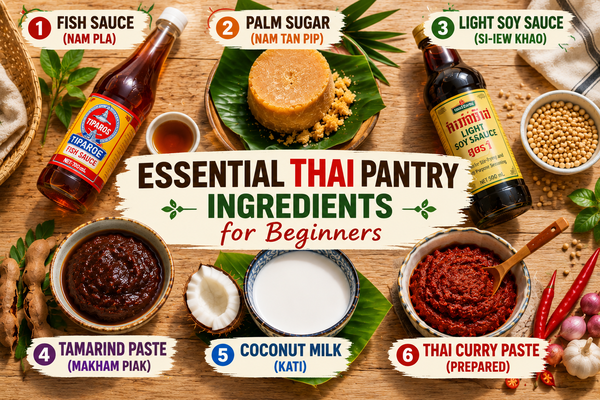
6 Essential Thai Pantry Ingredients for Beginners Cooking Thai food at home doesn’t have to be intimidating! If you love the vibrant flavors of Thai cuisine and want to recreate them in your own kitchen, you don’t need to buy out the entire Asian market. With just these 6 essential Thai pantry staples, you can easily cook authentic and delicious Thai dishes anywhere in the world. 1. Fish Sauce (Nam Pla) – The Ultimate Umami Booster What it is: A savory liquid made from fermented fish and salt. It provides a deep, salty, and savory flavor. How to use it: Use it in soups, curries, stir-fries, and dressings instead of table salt to build depth. Pro Tip: Look for bottles labeled "First Extract" for the highest quality and balanced taste. 2. Palm Sugar (Nam Tan Pip) – Subtle Natural Sweetness What it is: An unrefined sugar derived from coconut or palm sap, offering a rich, caramel-like sweetness similar in flavor profile to maple syrup. How to use it: Essential for balancing the heat and acidity in Thai curries, Pad Thai, and Green Papaya Salad (Som Tum). Pro Tip: If you can't find palm sugar in your local Asian store, maple syrup makes a great substitute! 3. Light Soy Sauce (Si-Iew Khao) – Clean Savory Flavor & Vegan Alternative What it is: A lighter, savory soy sauce that adds rich umami without darkening the natural colors of your ingredients. How to use it: Ideal for stir-fried dishes, such as stir-fried vegetables and fried rice, where a clean, savory taste is needed. Pro Tip: For vegetarians, vegans, or those with seafood allergies, light soy sauce serves as a fantastic plant-based alternative to fish sauce. 4. Tamarind Paste (Makham Piak) – Smooth, Deep Sourness What it is: A tangy paste made from the fruit of the tamarind tree that provides a deep, mellow sourness, unlike the sharp acidity of fresh lime juice. How to use it: Adds a complex fruity tartness to iconic dishes like Pad Thai and Kaeng Som (Thai Sour Curry), and serves as a key base for various Thai dipping sauces (Nam Jim). Chef’s Secret: Because of its smooth flavor, some chefs combine both tamarind paste and fresh lime juice together to achieve the ultimate balanced tartness, depending on the specific recipe. 5. Coconut Milk (Kati) – The Creamy Heart of Thai Curries What it is: The rich liquid extracted from grated mature coconut meat. Pro Tip: High-quality canned or boxed coconut milk works wonderfully for beginners making Green Curry, Red Curry, or Panang. 6. Prepared Thai Curry Pastes – Your Cooking Shortcut What it is: A concentrated paste made from fresh aromatics like lemongrass, galangal, kaffir lime peel, garlic, and chilies. Pro Tip: As a beginner, you don't need to make curry paste from scratch. A good store-bought paste saves time while delivering authentic flavors. Mastering Thai cooking starts with understanding these basic building blocks. Want to take your skills to the next level and learn how to balance these flavors like a local? Join our hands-on class at CLASSIC HOME COOKING and discover the secrets behind your favorite Thai dishes!


what's app